
Saturday, July 31, 2010


Friday, July 30, 2010
Fisherman’s Bay to Fossil Bay

We woke to thick fog in Fisherman’s Bay on Lopez Island so opted for a slow start to the day. After lounging around on the boat drinking coffee until 9:30, we finally went for a run around the bay and out the spit, then got showers at the Island Marina. By noon the sun was shining brightly, and we headed toward our weekend destination: Sucia Island a couple of miles north of Orcas Island and the northernmost of the San Juan islands.

As we cruised up the east side of Orcas, we had a wonderful view of Mt. Baker to the east. Twenty-five miles and 90 minutes later we pulled into Fossil Bay on Sucia Island, one of our favorite destinations on our annual trip to the San Juans.

This year for the first time we’re on a mooring buoy rather than tied up at the dock, thanks to our new bathroom facilities. We’ve spent the whole afternoon gloating over our good fortune as we’ve watched boats fight for limited space on the dock, even rafting in one case. We’ve also observed a large volume of smoke spilling from the multiple BBQs spread across the dock. We’ve never been here on a weekend before and are amazed how busy it is. It’s 8PM and boats are still pulling in, though at this point they have to anchor, as the buoys and docks were full by 3PM.

Because we just bought the boat and outfitted it in a hurry for this trip, we’ve had a few “learnings”. One of them is that things lashed to the swim-step jiggle a lot. Our tender, an 8-foot rigid inflatable boat (RIB), is not yet connected by a davit, so it jiggled one of its’ oars off the boat which was then lost at sea! We bought a couple of cheap replacement oars on Lopez and spent time this afternoon modifying the oars to fit the tender. Here’s Cathryn hard at work. She did the planning, while Bob handled the execution (drilling).
Tomorrow we plan to hang out here on our buoy, reading or possibly going ashore for a walk; we ARE having lots of fun!
Thursday, July 29, 2010
Underway Northbound

Yesterday afternoon we left the Narrows Marina in Tacoma under warm, sunny skies and headed to Seattle, where 90 minutes later we tied up at Bell Harbor Marina downtown. Shortly our daughter Mackenzie arrived via her new commute vehicle, “Scoot” (see photo) quickly followed by her husband Matt. After a quick tour of the new boat, we headed offshore from Alki Beach, cut the engine and floated for a couple hours while we ate a picnic dinner. It was warm, calm and oh so pleasant!

We slept on the king-size bed in the salon, much better than last week as we’ve added a Tempur-Pedic pad to soften things a bit. This morning we left Bell Harbor at 8am and arrived at Lopez Island at 1pm following a fuel stop in Edmonds and a route through Deception Pass instead of our usual Strait of Juan de Fuca crossing. Though we might go via Juan de Fuca again in the future, we’ll likely only do so under completely calm, clear, balmy skies as we found Deception Pass much preferable, though it’s a few miles out of the way, and the Pass itself can be tricky depending on tides and currents. Today it was a little adrenaline producing only because we’d never done it before, and it’s narrow with a lot of traffic and fast water.

We met our good friends Mary and Agnes, who own a house at Swift’s Bay here on Lopez, at the always fabulous Bay Café for appetizers and drinks. They have FIFTY relatives here for the week to celebrate Agnes’s mother’s 90th birthday, so couldn’t stay for dinner, but we did, and enjoyed delicious Calamari Steak (a new variant for us), Golden Beets with Gorgonzola, Mussels and Pork Tenderloin.
Back at the boat Bob is figuring out how to tether Cathryn’s netbook to his Android so we can have wi-fi on the boat and deal with photos, blog writing, email and reading the newspaper anywhere we have a cell signal. The lengths we go to in order to avoid withdrawal symptoms – from our Internet Addictive Disorder, that is! It’s a sunny, mild evening, and we’re enjoying sitting in the cockpit reading and blogging. Ah, the Good Life!
We remain comfortable and happy with the new boat and are still working to finalize a Name, so anyone who wishes to participate in the Boat Naming Contest, feel free to post a comment . . .please!
Oh, and we just sent a SPOT satellite message which has astonishing detail in the photo (down to the exact marina slip at which we’re parked) so check it out in the top right hand corner on the Tab that reads “Spot US” to see our location.
Saturday, July 24, 2010
Maiden Voyage

As part of our ongoing and ever-evolving quest for a near perfect existence since retirement 3 ½ years ago (“set no small goals”, we say!) we’ve sought to balance our various interests. During the winter we’ve adopted travel to Baja in our 21-foot 5th wheel trailer as the ideal way to spend time. During the late spring and summers here in the Northwest we’ve enjoyed road trips like the recent one to Alaska, and staying at home on Puget Sound. Here at home we’ve kept an older 23-foot power boat which we’ve used mostly for day cruises and to take the kids wakeboarding, with an occasional overnight trip, staying at state park docks or marinas with our camping gear.

One year ago we upgraded from our 72-square-foot Chalet A-frame Trailer for Baja travel to our “giant” 160-square-foot 5th wheel trailer. Last week we upgraded our boat from the23-foot cuddy cabin to a 27-foot pocket cruiser. This week we took the new boat out for her three-day maiden voyage. Our purpose, other than to just get out on the water, was to familiarize ourselves with the boat and figure out what we need to bring or buy to stock the boat for longer cruises.
![bigmap[1]](https://blogger.googleusercontent.com/img/b/R29vZ2xl/AVvXsEhSR_LXlsoH2O_XZL6qO5R0HAwLjAFRO6381OARTlO7vohW2csatgnlZ6j9F2bEzGynBbjskr__qEQXcfti6C9KZfEOoCBwRe32V8z1QMcTw_4WPupprIHILttCzKD-rfHw0o1QEnM3taA/s1600-h/bigmap%5B1%5D%5B7%5D.gif "bigmap[1]")
So for our first trip, we cruised into the familiar territory of south Puget Sound. Leaving the marina near the Tacoma Narrows bridge where the boat is temporarily moored, we headed south around Fox Island, then past the south end of the Key Peninsula, and continued to the north end of Harstene Island to Jarrell Cove State Park. There we hooked on to a mooring buoy in the middle of the cove. This is the sort of thing we’ve always wanted to do, but the lack of “facilities” on the old boat always kept us tied up at a dock where we could access the park’s or marina’s facilities.

We were joined a few hours later by our friends and neighbors George and Josi, who moored just fifty yards away. We spent two nights at Jarrell Cove and took turns preparing dinner onboard our boats. During our stay we took our tender to shore so we could run on the roads, or walk in the forest, and took a day cruise on Case Inlet and Fair Harbor marina.
It was a great first trip, and the new boat lived up to all our hopes. Next week we leave for a 12-day trip to the San Juan Islands, and possibly further north into the Canadian Gulf Islands if the weather cooperates. We’re getting closer to our goal: a near perfect existence!
Sunday, June 20, 2010
7,818 Miles

We’re home! We can hardly fathom that we covered 7,818 miles in only 5 weeks. British Columbia, The Yukon Territory, Northwest Territories and Alaska are VERY big places! We totaled more miles than if we’d driven from Seattle to the Florida Keys and back. Quite a few more. As we’ve written more than once, we have a new appreciation for what the word “vast” means.

A trip such as the one we’ve just completed is well worth taking. Other than our 2008 trip to Africa in which we went on safari, we’ve never seen such an amazing collection of wildlife. It simply doesn’t exist anymore in the lower 48, Europe and other places we’ve traveled. Seeing animals in their natural habitat is a very moving experience, nothing like seeing them in photos or a zoo.

Additionally, experiencing a chunk of the planet in its much more natural state further heightens our appreciation for the environment, and our concern for the abuse we people are heaping upon it. Trees, glaciers and animals are all in serious jeopardy. Why we humans think we can continue to survive if everything else on the planet continues to decline completely eludes us. We’re not oblivious to the irony in noting that we burned 600 gallons of fuel, and that each gallon burned produces 20 pounds of carbon dioxide, to make this trip. Bob is feeling guilty enough that he’s researching ways to buy carbon offsets.

So, to our family and friends: we hope to see you soon! To our fellow travelers and blog readers we’ve never met: we hope you’ve enjoyed traveling with us through this blog, and we hope we may enjoy reading your blog, or even meeting you somewhere along the road. Happy travels!

Thursday, June 17, 2010
Chainsaw Carving and Horses
Chetwynd, where we spent last night, calls itself the “Chainsaw Capital of the World”. And for good reason perhaps. Chetwynd is not a large city, or town, but it appears to have as many chainsaw sculptures as residents. Maybe more. We had no idea just how creative and interesting chainsaw carvings could be! Check out the display at the southern entrance into the town. Then imagine the rest of the town with scatterings of sculptures, as well as many individual homes displaying their own carving.


“The Horse” (that would be us) is now galloping back to the barn. We’re on our way to Penticton where we’ll visit friends, then cross the border back into the U.S. the following morning, then to our home4-5 hours later. We’ve loved this trip, and we’re eager to return to our own bed, bathroom and home, and looking forward to re-connecting with family and friends. What a journey . . . a little under 8,000 miles in one month plus one day!
Wednesday, June 16, 2010
No Excuse: Highway Robbery

We drove from Fort Nelson to Chetwynd, B.C. via the Hudson Hope Highway today. Wildlife sightings totaled one fox and one black bear. The Alaska Highway between Fort Nelson and Fort St. John was the best piece of highway (in terms of quality of the surface) we’ve traveled on the whole trip, and it was fun looking off to the north side of the road and seeing several stretches of the “old highway” winding back and forth through the woods. The Hudson Hope Highway travels through the Peace River Valley which was absolutely gorgeous! Signs along the highway suggest there’s a new dam being proposed, which is far from universally popular (there are already two on this stretch of the river). We don’t know the details, but ceding any portion of the Peace River Valley would be quite a loss.
Now on to the topic which produced the headline for today’s post. Since we don’t have much to report on today’s journey, and because we know several people are following our blog as they prepare for their trip north, let us report on what we think was the biggest rip-off we experienced on the entire trip.
![gas_prices[1]](https://blogger.googleusercontent.com/img/b/R29vZ2xl/AVvXsEgfO05Ef9s2e3dveuJWV-I1ou6HFgMDTDiq1NzcK2L5ngXpNgv6BwSTWemHM1Rwq8LnwZtjAINZEWifFLEvsz8O-FXviH7LDhLkraRpXtv6Ck1X0o4V1qDgZO8fOkEt62ChfM3YH5Dl_xo/s1600-h/gas_prices%5B1%5D%5B7%5D.jpg "gas_prices[1]")
Yesterday after we left Liard Hot Springs and drove south, we passed a couple of gas stations, but because we still had more than half a tank, we kept on driving, thinking we’d fill up somewhere further down the road. By the time we got to Muncho Lake Provincial Park we needed fuel to make it to Fort Nelson. So we pulled into the Northern Rockies Lodge which advertises itself as the “only full service resort between Watson Lake and Fort Nelson”. We pulled up at the pump and did a double take: could the pump really say $1.72 per liter ($6.47/gallon U.S.) for regular gasoline? We had only paid $1.42 a liter ($5.34/gallon U. S.) in Inuvick, 200 miles north of the Arctic Circle. Yep, that was the price. We bought the absolute minimum it took to get to Fort Nelson.
![rockies-lodge-muncho[1]](https://blogger.googleusercontent.com/img/b/R29vZ2xl/AVvXsEjKMvO1z9TyerXA1ICKfU0YqbpvPjHyKdf9I9DglL3spz7i1mqta_zsA3RTUj-FYFdmWFrYnn39YP29KCZxtksDbylYFPC1xq_a4tJ8XSrf18cGX5siuT00qmCI9tfAyDSjYCPTrNWjzvM/s1600-h/rockies-lodge-muncho%5B1%5D%5B3%5D.jpg "rockies-lodge-muncho[1]")
We know it costs more to get fuel into these remote areas, but we saw prices $0.50/liter less within 50 miles on each side of this resort. So there is no excuse for this price; it is nothing more than greed. If you’re passing this way, we encourage you to plan ahead and make sure you drive right by this rip-off. OK, we got that off our chests.
Tuesday, June 15, 2010
Down time at the Hot Springs; Bison not Buffalo

We left our boon dock location this morning and drove 50 miles to Liard Hot Springs. This is a provincial park and quite popular. The main hot springs are half a mile from the parking lot via a boardwalk, and have restrooms and changing rooms at the pools. If you go here, consider walking 5 minutes beyond the main pool to the Beta Pool.

This pool is deeper and cooler than the lower springs, but when we walked there after getting out of the main pool, no one else was there! The lower pools were quite warm depending on where you sat, up to 110 degrees, but with other spots that were closer to bath temperature.

While there were perhaps 25 people in the pool, it’s large enough that it didn’t seem crowded and we weren’t forced to converse with other people as we relaxed. Worth the stop.

After the hot springs we traveled mostly east, just south of the Yukon Territory/British Columbia border to Fort Nelson, BC where we’re spending the night. There has been a clear change in the landscape since we left Whitehorse. We don’t know the terminology, but the northern spruce forests and permafrost landscape has changed to pine and birch forests and a more Rocky Mountain/Cascades environment. One other change we noticed: Bob got up briefly about 2am last night and . . . . drum roll . . . . it was ALMOST DARK!
As we drove along today, another change occurred. The signs which before always warned to be on the lookout for moose, have changed to be on the lookout for buffalo, and we saw LOTS!!

One editorial comment: Despite the official Government of Canada signs warning us to be on the lookout for buffalo, a Google search convinces us we were actually seeing bison. We’ll let you do your own research if you want to find out the difference. And one final note about wildlife and highways living in close proximity: at several points along the Alaska Highway we’ve seen signs announcing “245 moose-vehicle collisions so far this winter – slow down!” Today we noticed a truck off in the ditch, trees and bushes on the south side of the highway (no person inside) and a dead bison on the adjacent north side. We didn’t take photographs, but took this to be a more graphic warning of the consequences if one fails to take seriously the warnings to keep alert for wildlife near the highway.
Monday, June 14, 2010
Somewhere North of Liard Hot Springs
We left Whitehorse at 9:30 after our wonderful socialized medicine experience with a couple of options available to us: 1) stop about 100 miles east at Teslin Lake to go kayaking if the weather looked good, or 2) continue on to Watson Lake. Option one didn’t work out due to clouds, cold and wind, so we went with option two. When we arrived at Watson Lake at 3pm it was still rainy and cool, and we couldn’t divine any real reason to stop as we’d been here on our northbound journey and already seen the sights. So again, we continued on, east by southeast and re-entered British Columbia. As we drove, we saw pairs of buffalo in two locations (our first of this trip) and a young grizzly bear, all immediately adjacent to the road.


Around 4:30 we tired of driving but weren’t near any destination. The Liard River paralleled the road, so it occurred to us perhaps we could find a spot to boon dock. And did we ever! We spied a dirt road on the south side of the highway and pulled over to investigate. What we found was a camping spot 200 yards off and invisible from the highway, with a view of the river surrounded by a dense grove of birch trees. We checked it out, Bob did a little tight maneuvering and parked in the perfect spot. And the sun was out! Bob began work outside the trailer dropping the stabilizer legs, pulling out the camp chairs and planning to have a beer while gazing at the river.


After our heartbeats subsided, we settled by the river and had our beer, but we played some music loud enough that no bear or moose would be surprised we were around, and kept our can of wasp spray close at hand! Oh, you wonder why we have wasp spray? It’s illegal to transport mace or pepper spray into Canada, we don’t carry guns, and we’d read that wasp spray is actually better than mace or pepper spray because it’s easier to aim and the spray shoots farther, so whether you’re concerned about animals or human intruders, wasp spray is a good weapon!
Alaska, here they come!

On our northbound journey we often drove many miles between sightings of other vehicles and stayed in campgrounds which were relatively empty. Since we left the Kenai Peninsula 4 days ago, we’ve noticed a sharp up-tick in the number of RVs on the road and campers in the campgrounds. Last night was the strongest indicator yet that the summer migration of folks headed to Alaska has begun in earnest. Two weeks ago we stayed at the Hi Country RV Camp just outside Whitehorse, a large place with more than 100 sites which was perhaps 20% full. Last night we stayed there again and found it more than 90% full. Today on the Alaska Highway there’s a steady stream of pickup trucks with campers, motor homes, and trucks pulling trailers all headed north, as we head south. Our friend Gene (the camp host at Deep Creek Beach) had told us we’d be traveling on the “shoulders” of the primary summer season of travelers, and would encounter smaller crowds as a result. The last few days confirms the accuracy of that statement as the highway now looks like a river during salmon-spawning season, only in this case the fish are RVs!
Socialized Medicine, round 2
We’ve had a second occasion to sample the offerings of that nasty Canadian “socialized medicine” we keep hearing about in the U.S. news. Cathryn developed a minor eye infection and hoped it would clear on its own, so hasn’t been wearing contact lenses for a bit. No such luck. Yesterday on arrival in Whitehorse, we asked for directions to a walk-in clinic and learned it opened at 9am Monday. As we wanted to be on the road quickly, we arrived early this morning in hopes of being patient #1 of the day. At 8:45 a.m. Cathryn found the clinic doors open, walked in, and found Dr. Bekhit there alone, as the receptionist hadn’t arrived for the day. On seeing Cathryn enter, he greeted her, had her fill out a brief information sheet and health history, and took her into an exam room. Ten minutes later, having paid her $60, she walked out with a prescription for Tobramycin optical drops and directions to a nearby pharmacy, where the prescription was filled in 10 minutes for $15. We’re sure Canada’s medical system has its faults, as all do, but so far based on two encounters, we’re utterly charmed by the ease, cost and quality of care we’ve received.
Saturday, June 12, 2010
Kluane Lake and Some Alaska Observations
![akusa_trans_sm[1]](https://blogger.googleusercontent.com/img/b/R29vZ2xl/AVvXsEiQdQv6_59_2k_9yP797dRVDpGYGCELiGI3_GIKJPGuynFu6Qupca_CW_POkwcci0xM371hj3lUMf-YwPhO4GP1j8ShD35stYNooeHfPhKhDi-Mcb7MFj5VoSQwKbvLLllv3fzwwtSy8uo/s1600-h/akusa_trans_sm%5B1%5D%5B3%5D.gif "akusa_trans_sm[1]")
We’re at Kluane Lake in Destruction Bay, Yukon Territory, 200 miles east of Tok. We plan to spend two nights here, kayaking on the lake if the weather cooperates. We thought we’d offer some initial impressions of Alaska.
In short, two words: vast and empty.
Vast: The size of Alaska is equal to 20% of the surface area of the lower 48 states (bigger, even, than Texas) and only has about 600,000 people in the entire state. The southern portion of Alaska is a lot like where we live in the Puget Sound region of Western Washington: very green, except the trees are mostly White or Black Spruce, not Douglas Fir, and there are more deciduous trees; and mountains, except the mountains are all a few thousand feet higher than ours at home.
Empty: To give some perspective to those of you in the Puget Sound area about how empty it feels, imagine western Washington if Seattle/King County only had 237,000 residents (its population in 1910) and the rest of western Washington were proportionally reduced in population. Given the topography and vegetation of the Puget Sound region, and this reduced population, you begin to have a sense of what it feels like up here. Except Alaska is about 50 times the size of western Washington. It’s astonishing how little traffic there is, how few freeways (only one near Anchorage we’ve seen), and how few people we see anywhere we go.
We’ll add more observations later, but will start with these.
Moose, Frost Heave and Mosquitoes
Ever since we began our research for this trip, three things we were warned about, repeatedly, were moose leaping in front of vehicles, frost heave on the highway, and mosquitoes the size of bats! After a month on the road, never having a problem with any of the afore-mentioned threats, we’ve become sanguine. Well, today proved it’s never a good idea to let your guard down on a road trip to Alaska!

Just after heading down the highway east from Tok, AK this morning, Bob yelled “Moose!” Sure enough, leaping out of the trees and bushes on the side of the highway, not far in front of our truck, was a large female moose! Cathryn hit the brakes while Bob grabbed his camera and started clicking away, even as the moose quickly disappeared into the bushes on the opposite side of the highway. No harm, no foul, just an adrenaline rush that took some time to subside.
“Milepost” serves as the Bible for Alaska road travelers, a book which describes, literally mile-by-mile, the entire length of the various highways from the lower 48 and throughout Alaska, telling history, what services are available, location of visitors centers and campgrounds and much more. About the stretch of road we traveled today, from Tok, AK to Destruction Bay, Yukon Territory (YT), Milepost has this to say: “According to Public Works Yukon, much of the soil along the north Alaska Highway is of glacial origin and unsuitable for road embankments. Anything that causes the permafrost to melt will cause the ice-rich soil to liquefy, and liquid soil has little strength and will settle or subside. Then if this soil refreezes during lower air temperature, it will expand or heave. This process wreaks havoc on the drivability of the road surface by creating undulations and cracking.” Well, in our view, this is an understatement! This segment of highway is reportedly the worst the entire length of the Alaska Highway, and we found ourselves driving 30 mph much of today. On arrival at Kluane Lake at the end of the day, we found inside the trailer that two upper cabinets had popped open despite taking the extra precaution of securing them with bungee cords on the door pulls, and several items had fallen to the floor – fortunately none made of glass! No snoozing today while riding shotgun, as the road was simply too rough.

The large mosquitoes are out in droves here at Kluane Lake, despite the fact it was 49 degrees, overcast, and the wind blowing hard enough to raise white-caps on the water on our arrival. We’d have liked to sit outside, but the weather prevented it, so the mosquitoes didn’t bother us at all tonight. And we have a spectacular campsite, (dry camping with no hook-ups) right on the shore of the beautiful lake, with no other campers in sight. We remain happy and well!
Friday, June 11, 2010
Back at Tok AK
![frs4165[1]](https://blogger.googleusercontent.com/img/b/R29vZ2xl/AVvXsEivO1uIDbflk_y1v5oYKFLzf58S9vzq8X4TZv0MLQiRo5dGRlbp-H3aLZWQVSNb8kRjo0BRM5j2-g5RivFI6Lq6TqMlU7oZHo8RAFgswG2M8I7eIFgnI5BrlZBhbUOhA65v74x9oR4R7J4/s1600-h/frs4165%5B1%5D%5B3%5D.png "frs4165[1]")
We’re back in Tok, Alaska, less than two weeks after entering the mainland (there must be a term for the main body of Alaska that doesn’t include the panhandle of “Southeast”, but we don’t know what it is). We’re moving faster than we thought we would for a couple of reasons. One, Bob’s back continues to bother him a bit, and as a result we haven’t been able to do the hiking and kayaking we’d intended to fill our “no drive” days with, and second we’ve had some personal reasons to want to get back to Seattle a week or so earlier than we’d planned when we left home. We’ve been moving quickly, but have gone everywhere on the itinerary, and even added a few stops. The cooler, wetter weather since we’ve been on the mainland also contributed to our moving right along. We always intended this to be our “survey trip”, much like we thought of our first trip to Baja, and we’ve accomplished our objective. Now if anyone ever asks for an opinion on whether they should go to Alaska, or where they should go, they will get an ear full!
![alaska-1[1]](https://blogger.googleusercontent.com/img/b/R29vZ2xl/AVvXsEgh56Pnpl3mG_qy4RVt_eTRcjmopXdIU8hf47jGZLJpQOW6PnWBj62gbeqKxm100XdEgLC5nmC0Gd7hpHvwWkCLy_w4n2UUe005XZB7NlX6TB3nzqJg72F0grv-XAoWoovIjFo4sLC4ZIA/s1600-h/alaska-1%5B1%5D%5B3%5D.jpg "alaska-1[1]")
Bob hasn’t decided if he can handle another visit to Fast Eddy’s in Tok for another Musher Omelette tomorrow. He thinks we should go and split one; Cathryn’s thinking she’ll go for a run instead.
By the way, during the winter it gets to 80 degrees BELOW O here in Tok.
Thursday, June 10, 2010
Prince William Sound
We left Seward this morning and drove 60 miles to the Williwaw Campground near Portage, most of the way north up the east side of the Kenai Peninsula. We parked the trailer and drove 5 miles further to the Whittier tunnel, a 2 ½ mile ONE-lane, dual-use (autos and trains, so rails are laid in the single lane) tunnel mined through solid rock.
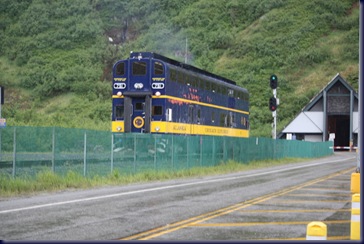
After paying our $12 round-trip toll, we passed through the tunnel (which opens only once each hour for travel in each direction) to arrive at the Town of Whittier, which serves as the Port of Alaska. We’re told that 2/3 of the water-borne freight coming to Alaska arrives here. It’s also the closest Alaska Marine Highway (ferry) terminal to Anchorage and Fairbanks. Whittier has a total year-around population of 170, 85% of whom live in a single, large 11-story apartment building as there is NO single family housing here. Talk about a company town! Whittier also receives 170 inches of rain each year, which may go a long way toward explaining its’ population of 170!

From Whittier, we embarked on a 150-passenger boat which was mostly full, for a 5 ½ hour cruise. We saw it all: eagles, humpback whales, sea otters, waterfalls, icebergs, hanging glaciers, tidewater glaciers and thousands of black-legged kittiwakes! We’ll let the pictures tell the story; there are a few included here, plus a link to a Picasa Web album click here. We encourage you to go to the link and play it as a slide show. Bob was lucky enough to capture on camera a calving of a hanging glacier that came down a waterfall channel to the water. It makes an amazing series of about 10 pictures as the ice cascades down the waterfall. If the link doesn’t work, you should be able to reach it by going to the “slideshow” tab at the top of the page, and look for the slide show titled “Prince William Sound”.


http://picasaweb.google.com/BobWhite1/PrinceWillaimSound?feat=directlink

After paying our $12 round-trip toll, we passed through the tunnel (which opens only once each hour for travel in each direction) to arrive at the Town of Whittier, which serves as the Port of Alaska. We’re told that 2/3 of the water-borne freight coming to Alaska arrives here. It’s also the closest Alaska Marine Highway (ferry) terminal to Anchorage and Fairbanks. Whittier has a total year-around population of 170, 85% of whom live in a single, large 11-story apartment building as there is NO single family housing here. Talk about a company town! Whittier also receives 170 inches of rain each year, which may go a long way toward explaining its’ population of 170!

From Whittier, we embarked on a 150-passenger boat which was mostly full, for a 5 ½ hour cruise. We saw it all: eagles, humpback whales, sea otters, waterfalls, icebergs, hanging glaciers, tidewater glaciers and thousands of black-legged kittiwakes! We’ll let the pictures tell the story; there are a few included here, plus a link to a Picasa Web album click here. We encourage you to go to the link and play it as a slide show. Bob was lucky enough to capture on camera a calving of a hanging glacier that came down a waterfall channel to the water. It makes an amazing series of about 10 pictures as the ice cascades down the waterfall. If the link doesn’t work, you should be able to reach it by going to the “slideshow” tab at the top of the page, and look for the slide show titled “Prince William Sound”.


http://picasaweb.google.com/BobWhite1/PrinceWillaimSound?feat=directlink
Wednesday, June 9, 2010
On to Seward, AK
We left Deep Creek Beach on the southwest side of the Kenai Peninsula this morning after saying goodbye to Gene and Joyce, our bloggin’ friends who are now real friends. We drove 140 miles: first north, then east, then south to reach Seward which sits at the end of the road on the southeast side of the Kenai. This is still serious fishing country, but fishing doesn’t seem to overshadow all else as it does on the west side. It also has more varied terrain in terms of proximity to the mountains than does the west side.

After dropping the trailer at the Bear Creek Campground, we drove 9 miles on a side road to the Exit Glacier Visitors Center. From there it’s possible to hike a mile to reach the toe of the glacier, which we did. Exit Glacier is a relatively small tongue of ice flowing from the larger Harding Ice Field. What it lacks in grandeur is made up for by its’ ease of access. We also learned a new word: katabatic. This is a special type of drainage wind that results from cool, dense air that sinks and flows down over the glacier to the valley, with the temperature and density differential causing the stronger, colder wind. Brrrr – we felt it!
We drove back to Seward and spent the afternoon exploring this small seaport town. One unique feature of Seward: there are 4 or 5 municipal campgrounds that only cost $5-10 a night, right in the heart of downtown and mostly on waterfront property. These campgrounds are merely gravel lots with sites delineated by white chalk lines, but how can you complain given the price, view and convenience?!
Tomorrow we’re off to Prince William Sound for our last glacier fix before we start the journey back to the Yukon Territory, heading toward home.
Exploring the west side of Kenai

This morning we took off in the truck to meander through and photograph some of the places Gene took us last night. We visited Ninilchik’s Russian Orthodox Church and adjacent cemetery, noting how many of the gravesites were new, and how high a percentage of the folks buried there died at very young ages, even in recent years.

We also wandered through the tiny village of Old Ninilchik, situated on the shores of both the Ninilchik River and Cook Inlet. The village contains a tiny marina which can only be entered or departed at high tide – otherwise the outlet to Cook Inlet is a very shallow stream.

Leaving the Ninilchik area we headed south on the Sterling Highway toward the city of Homer, taking a 14-mile detour through the Village of Nikolaevsk, a Russian orthodox community of folks who continue many traditions from “the old country”. 
Finally we arrived at Homer, a city of 5,500 residents at the southwest end of the Kenai Peninsula. The city consists of “downtown” on the hill above Kachemak Bay, surrounded by gorgeous snow-capped volcanoes and peaks of the Alaska Range, and the Homer Spit, a 4 ½ mile strip extending into the bay, with restaurants, shops, hotels, campgrounds and a marina, including a small deep-water dock with room for one cruise ship (which arrives once every two weeks in summer). We had lunch at Captain Pattie’s on the beach and both had halibut, which we noted tasted fresher and more delicious than any we’ve purchased in Seattle, ever.
We enjoyed the Pratt Museum, an art, culture and natural history museum at which we spent more time than expected given its’ small size – but it had terrific exhibits, including an informative video about the Exxon Valdez oil spill 21 years ago, which seemed timely given what’s going on in the Gulf of Mexico at the moment. We visited other shops and galleries, and drove through the East End Road residential area.
At 5:45 we met Lea Miner, niece of our very good friends Phebe and Jim Richards, at the “Cups Café”, a super fun, artsy restaurant on the hill, for dinner. Lea has lived in Homer year-round for 10 years. The food was creative and delicious, including fabulously fresh seafood, and we had a lively conversation with Lea who was enthusiastic and gracious in satisfying our curiosity about year-round life in Alaska. She grew up in Boston and has very happily settled into life in Homer, including the long, cold winters, and loves the beauty, remoteness, outdoor emphasis and life in the lovely town at the end of the Kenai Peninsula. What an enjoyable evening! And we made one mistake: we were so absorbed in the conversation we forgot to take a photo of the 3 of us together, despite having our camera with us!
We both concluded Homer is our favorite Alaskan town so far, and though the Spit is quite touristy, it has a real downtown that’s appealing and accessible.

The volcanoes of Mounts Redoubt, Iliamna, Augustine, and Douglas, adjoined by the mountains of the Alaska Range and numerous glaciers provide exceptional scenery, and proximity to the water provides mild winters by Alaskan standards. We’d also note that summers are “chilly” to our taste – averaging 60 degree high temps in July and August, and colder the rest of the year. Today was sunny and 53.
Subscribe to:
Comments (Atom)